Industrial Electrical System Safety Standards Guide
Quick Summary
Industrial electrical system safety standards are the federal and national rules that govern electrical work, equipment and people in plants, warehouses and commercial buildings. The core baseline is OSHA 29 CFR 1910 Subpart S, supported by NFPA 70E for work practices and the NEC for installation design.
OSHA 29 CFR 1910 Subpart S is the federal baseline for general industry electrical safety.
Only qualified persons may work on or near exposed energized parts, with training documented under 1910.332.
Lockout/tagout procedures must follow 1910.147 and be reviewed periodically and after any change.
Arc-flash labels must be updated after any system change, since they go stale when breakers or transformers change.
Table of Contents
Industrial electrical system safety standards are the rules that keep electrical work, equipment and people safe in plants, warehouses and commercial buildings. Electrical injuries are rarely minor, and the most serious ones often follow predictable failures: energized equipment that was assumed dead, an unqualified worker in a live panel, or a tool that was never inspected. This guide from O & J Property Solutions LLC explains which standards apply, how the main federal and national codes fit together, and what a practical safety program looks like on a working property. Electrical system safety is a shared responsibility between the building owner, the managers who run it and the people who touch the equipment.
Last Updated: November 13, 2026
Why Industrial Electrical System Safety Standards Matter
Electrical hazards are a leading cause of serious workplace injury and death. The University of South Florida reports that as many as 39% of electrical fatalities could have been prevented through safety devices (University of South Florida public health director's column, 2026). That figure is a reminder that most electrical incidents are preventable, not unavoidable.
Standards give a facility a common baseline. They define who may work on energized equipment, what protective equipment is required, how circuits are de-energized, and how hazards are labeled. Without them, safety depends on the habits of whoever happens to be on shift.
OSHA Electrical Safety Standard 1910: General Industry Requirements
29 CFR 1910 Subpart S is the federal baseline for electrical safety in general industry, and it is organized into three parts that facility teams should treat separately because they trigger different obligations. Subpart S, Part I (1910.302 through 1910.308) covers electrical utilization systems: wiring design and protection, wiring methods and materials, and general equipment requirements. Part II (1910.331 through 1910.335) covers safety-related work practices for both qualified and unqualified workers. Part III (1910.399) is the definitions section, and the definitions matter because terms like "qualified person" and "energized" carry enforcement weight.
The practical obligations under Part I include guarding live parts against accidental contact, maintaining equipment in a safe condition, and keeping enclosures and covers in place. Part II covers the safety-related work practices that apply day to day. Employers must train workers on electrical hazards, provide and require the use of protective equipment, ensure that live parts are de-energized before work (with limited exceptions for infeasible de-energization or justified energized work), and use lockout/tagout procedures consistent with 1910.147.
Subpart S, Part I and Part II address different obligations, so treating it as a single checklist can miss distinct requirements.
Qualified Persons and Worker Training
A qualified person is defined in 1910.399 as someone who has the training and knowledge to recognize and avoid electrical hazards and to work safely on the equipment assigned. Familiarity with a panel is not qualification. Under 1910.332, training must cover the safety-related work practices and the hazards associated with the specific equipment and voltage the worker will encounter, and it must be documented.
Employers should be able to show that workers can identify the voltage present, verify de-energization, select protective equipment, and follow the facility's procedures. That is where NFPA 70E becomes useful: it is a consensus standard, not a regulation, but OSHA references it as a recognized way to meet the work-practice requirements in Subpart S.
OSHA Electrical Safety Standard 1926: Construction Site Requirements
Construction sites fall under 29 CFR 1926 Subpart K, which sets requirements for temporary wiring, grounding, ground-fault protection and work near energized lines. Temporary power is a frequent source of problems on job sites: cords are damaged, receptacles lack protection, and grounding is incomplete. Inspect extension cords and portable equipment before each use and remove anything with exposed conductors.
If your property is undergoing renovation or expansion, identify which work falls under construction rules and which falls under general industry rules before work begins. The two sets of requirements can overlap, and assumptions about which applies are a common source of gaps.
How the National Electrical Code and NFPA 70E Fit Together
The National Electrical Code (NEC), published by the National Fire Protection Association as NFPA 70, governs how electrical installations are designed and built. It is adopted by most states and local jurisdictions, which usually make it enforceable through permits and inspections.
In practice, the NEC tells you how a system should be built, and NFPA 70E tells you how people should work on it. OSHA references NFPA 70E in places, which is why both documents matter on an industrial property. Your local adoption of the NEC determines the edition you must follow, so confirm that with your building department.
Electrical Hazards Examples in Industrial Facilities
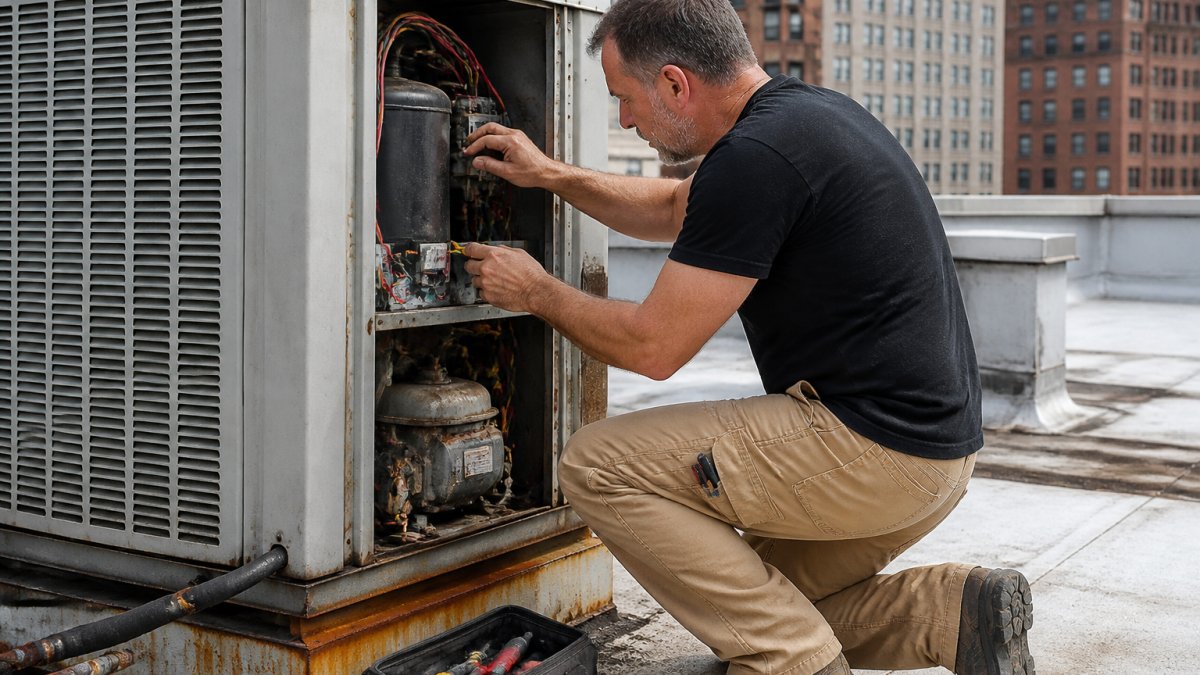
Common hazards in industrial and commercial buildings include overloaded circuits, damaged cord insulation, panels left open, and equipment whose grounding was disturbed during a repair. To see how complex electrical systems in commercial buildings are handled in practice, read Handling Complex Electrical Systems in Commercial Buildings. Each one can cause a shock, a fire or an arc event. A typical pattern is a motor starter that has been bypassed, or a receptacle that was added to a circuit never designed to carry the load.

Walk the facility with a checklist. Note any exposed conductors, warm connectors, missing panel covers, and cords run through doorways or under carpet.
Shock, Electrocution, and Arc Flash Risks
Shock occurs when current passes through the body, and the damage depends on the path and the duration more than the voltage alone. Electrocution is a fatal shock. Arc flash is a separate hazard: an electrical fault that releases intense heat and light, and can cause severe burns and pressure injury even when the worker never touches a live part. Arc flash is why labeling matters. Equipment should display the incident energy and the protective equipment required for work on it, based on an arc-flash risk assessment. Ask your electrical contractor to confirm that these labels are current after any change to the system.
Industrial Electrical Safety Practices for Facility Inspections
A useful inspection program is not a walkthrough checklist; it is a standards-to-action map that ties each requirement to a responsible role, a record, and an interval.
Requirement | Responsible role | Record or evidence | Typical interval |
Single-line diagram and panel schedules match installed equipment | Facility engineer or electrical contractor | Signed and dated drawing set | After any modification; annual review |
Panel and enclosure condition (covers, labels, moisture, heat) | Maintenance technician | Inspection form with photos | Monthly for high-duty areas; quarterly otherwise |
Cords, plugs, and portable equipment | Area supervisor | Tagged equipment log | Before each use; documented monthly |
Grounding and bonding integrity | Qualified electrician | Continuity test results | Annual; after any repair |
GFCI protection test | Maintenance technician | Test log with trip results | Monthly |
Lockout/tagout procedure for each energized task | Safety manager and qualified person | Written procedure, training record, audit | Annual procedure review; periodic field audit |
Arc-flash label accuracy | Electrical contractor or engineer | Risk assessment report and label inventory | After system change; reassess on a defined cycle |
Infrared thermography of switchgear and panels | Qualified contractor | Thermal report with exceptions | Annual, or more often for critical gear |
Protective equipment inspection | Safety manager | PPE inspection log | Before each use; documented monthly |
Two rows deserve more detail because they are where industrial facilities most often fall short. First, arc-flash labeling: NFPA 70E requires equipment to be labeled with the incident energy or arc-flash boundary and the required PPE, based on an arc-flash risk assessment. Second, lockout/tagout: 1910.147 requires a written procedure for each machine or system with a specific energy-isolation sequence, and the procedure must be reviewed periodically and after any change.
An inspection program that records findings but not closure dates can leave corrective action undocumented, so assign an owner and a due date to every exception. Close the loop by assigning an owner and a due date to every exception, and keep the closure evidence with the original finding.
For industrial equipment specifically, extend the inspection beyond panels and cords. Switchgear and motor control centers need thermographic scans and breaker exercise records. Variable-frequency drives need clearance and cooling-path checks per the manufacturer. Generators and automatic transfer switches need exercise logs and load-test records.
Scheduling Your Next Electrical Safety Review With O & J Property Solutions
An outside review can confirm what your internal checks may miss. O & J Property Solutions LLC provides commercial electrical services alongside HVAC and refrigeration work for commercial properties in Manteca, CA. Their site lists commercial HVAC, refrigeration and kitchen hood services if you want to see the full range, and you can contact O & J Property Solutions LLC by calling 209-679-2136 to arrange a review. Before you book, ask for a written scope that names the standards applied and the documentation you will receive.
Frequently Asked Questions
What are the OSHA standards for electrical safety?
OSHA's electrical safety requirements are primarily found in 29 CFR 1910 Subpart S for general industry and 29 CFR 1926 Subpart K for construction. Subpart S covers design safety, wiring methods, safe work practices, and equipment installation in most industrial facilities. Subpart K governs electrical work on construction sites, including temporary wiring, grounding, and worker protection. Employers should review both sets of rules based on the type of work performed, and should consult the current text of each regulation on the OSHA website to confirm applicable requirements for their facility.
What is the difference between OSHA electrical standards 1910 and 1926?
OSHA 1910 Subpart S applies to general industry, meaning manufacturing plants, warehouses, and most fixed industrial facilities. OSHA 1926 Subpart K applies to construction work, including temporary power, job-site wiring, and energized work performed during building projects. The two sets of standards share core principles such as grounding, guarding, and safe work practices, but they differ in how they address temporary installations and construction-specific conditions. Facilities that perform both maintenance and construction work may need to apply both standards depending on the activity.
What are the five main electrical hazards in an industrial facility?
The five hazards most commonly encountered in industrial facilities are electrical shock, electrocution, arc flash, arc blast, and electrical fires caused by overloaded circuits or damaged wiring. Shock occurs when current passes through the body, while electrocution is a fatal shock. Arc flash releases intense heat and light from a fault, and arc blast produces pressure waves that can cause physical injury. Frayed cords, exposed conductors, and overloaded circuits frequently contribute to these hazards. Regular inspection and proper lockout/tagout procedures reduce exposure to each of them.
How can industrial facilities identify and control electrical hazards?
Facilities identify electrical hazards by inspecting equipment, reviewing single-line diagrams, and performing a documented risk assessment for each energized system. Control measures follow a hierarchy: eliminate the hazard where possible, then apply engineering controls such as guarding and grounding, administrative controls such as lockout/tagout and qualified-person assignments, and personal protective equipment as the last line of defense. Arc-flash labels on equipment should be verified and updated when the system changes. Documenting each step supports both compliance and incident prevention.
Are ANSI standards mandatory?
ANSI standards are generally voluntary consensus standards developed by the American National Standards Institute and its accredited committees. They become mandatory only when a regulation, contract, or local code adopts them by reference. OSHA regulations sometimes reference ANSI or NFPA documents, which can make specific provisions enforceable. Facilities should check whether the authority having jurisdiction or their insurer requires compliance with a particular standard, and treat ANSI guidance as recommended practice where no legal requirement applies.
What are 20 important electrical safety rules?
Core electrical safety rules for industrial workers include de-energizing equipment before work begins, applying lockout/tagout, verifying absence of voltage with a rated meter, wearing arc-rated PPE appropriate to the hazard, using insulated tools, keeping clear of energized parts, and never bypassing interlocks. Other rules cover inspecting cords for damage, avoiding wet conditions near electrical equipment, keeping panels accessible, reporting defects promptly, and following written procedures. Workers should be trained on these practices before performing energized or de-energized electrical tasks, and the training should be documented.
Comments